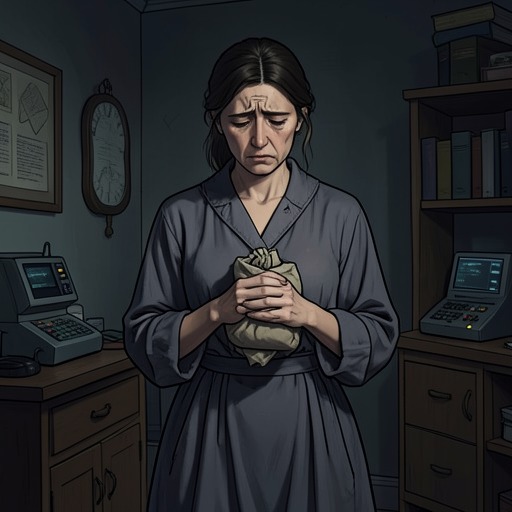
Motherhood, Loss, and Maternal Guilt
The Girl on the TrainMotherhood, Loss, and Maternal Guilt runs through the contrasting experiences of Rachel Watson, Megan Hipwell, and Anna Watson. Rachel’s unfulfilled longing for a child becomes a source of shame and isolation; Megan’s grief over Libby shadows her unexpected pregnancy; and Anna’s love for Evie sharpens her response to the threat posed by Tom Watson. Their stories show motherhood as both intimate attachment and a demanding social standard: care can be desired, performed, resented, or feared, but it does not erase grief or ensure safety.
Infertility and the measure of motherhood
Rachel’s history makes the absence of a child a defining loss even though there was no miscarriage. She and Tom tried to conceive, but no doctor could explain why she did not become pregnant. One round of IVF, the limit of what they could afford, was unsuccessful. Rachel recalls the treatment as unpleasant and its failure as a rupture in their relationship: Tom believed they could still be happy without children, while she felt unable to stop mourning a life she had never experienced.
That grief was made harder to contain by the attention other people paid to it. Friends and colleagues had children, and questions about when Rachel would become a mother turned her childlessness into a public subject. She felt the responsibility was placed on her, particularly after Tom fathered a child with Anna. The contrast reinforced her belief that she had failed at a role by which women were judged. Her account connects private infertility to a broader measure of female worth, while also acknowledging that she drank and that the pain did not excuse her drinking.
Rachel’s encounters with other people’s children expose how deeply the loss affects her relationships. At a park in Witney, during a break from police interviews, she watches mothers and childminders with children and remembers imagining herself bringing her own baby there. The scene holds an ordinary public place against the future she had pictured: instead of a family outing, she is alone with a sandwich between interviews. Earlier, she had helped Anna with Evie, but the work of childcare did not bring her closer to wanting a baby. After leaving the house, Rachel wanted to wash away the baby smell. Caregiving could therefore intensify her awareness of what she lacked rather than satisfy her longing.
Care, judgment, and the household
The novel places maternal care in practical settings as well as in Rachel’s memories. When Rachel visits to help Anna, her role is to watch Evie while Anna rests. Anna’s attention centers on the baby’s warmth and feeding, while Rachel feels like an extra person in a household where she has little adult companionship. Her experience complicates any simple opposition between a woman who wants a child and a woman who already has one: Rachel longs for motherhood but finds this particular form of care alienating, and Anna’s constant attentiveness appears to Rachel as nervousness.
The household also exposes how childcare can be neglected amid adult relationships. Anna remembers coming downstairs to find Megan and Tom standing close together while Evie cried in her high chair, neither of them looking at the child. This memory later informs Anna’s thoughts about Tom’s desire for Megan, but it also sets adult sexual secrecy beside a baby’s immediate need for attention. The contrast does not make Anna’s care perfect or remove her complicity in the household’s history; it reveals how the child’s vulnerability persists while the adults focus on themselves.
Motherhood also becomes a basis for judgment. After a news report alleges that Megan may have been involved in the unlawful killing of her own child and suggests it as a possible motive for her murder, Anna reads the story and concludes that she had always sensed something wrong with Megan. The report is presented as vague and based on unnamed sources, not as an established finding. Yet the allegation quickly becomes a moral verdict in Anna’s mind, accompanied by relief that Megan is gone. The gap between uncertain public claims and Anna’s certainty shows how readily suspicion about a woman’s fitness as a mother can become condemnation.
Megan’s loss and a pregnancy shadowed by fear
Megan’s pregnancy brings earlier loss into the present. She imagines the unborn child as a girl and cannot separate that possibility from Libby: thoughts of the baby call up Libby’s face and the memory of her death. Megan says she cannot hate the new child and wants to love her, but she is also afraid of what might happen to either of them. With Scott away, the silence and prospect of being alone intensify her anxiety. Her feelings are not a straightforward recovery from grief; attachment and fear occupy the same thoughts.
Megan turns to Kamal Abdic in a moment of panic. He comes to her home, listens, and tells her that she must forgive herself rather than continue running from what happened. Megan experiences his response as forgiveness for what came before. The conversation offers support, but it does not remove her uncertainty about how to face pregnancy, marriage, or the possibility of being alone with a child. Instead, it helps her think about responsibility as something she must choose in the present.
She eventually decides that she will love and raise the baby, and that she owes the child and Libby an effort to do things differently. Her decision is tied to a hoped-for reconstruction of herself: she has been many things, she reflects, but becoming a good mother is now something she must try to do. She also resolves to tell the truth rather than continue hiding or running. When she begins speaking with Scott, however, she has not yet told him about the pregnancy. She means to disclose the painful matters first, including the possibility that he is not the father, because she believes it would be cruel to present the pregnancy before that uncertainty.
Anna, Evie, and the limits of safety
Anna’s attachment to Evie becomes especially visible when Rachel tells her that Megan was pregnant. Anna asks whether the baby might have been Tom’s. Once she understands that Megan’s child would have been Evie’s sibling, she is overcome by grief and allows Rachel to comfort her despite their hostility. Rachel urges her to leave with Evie and stay elsewhere, but Anna initially refuses to leave Tom. The moment brings the women into a temporary alliance without making trust immediate: Anna is distressed by Rachel’s touch even as she cries beside her.
By the time Tom is attacking Rachel, Anna briefly imagines the disappearance of Rachel as the beginning of the family life she wanted with Tom and Evie. Looking at her sleeping daughter breaks that fantasy. Anna understands that she and Evie would not be safe, that Tom would not be able to trust her, and that another version of the same destructive pattern could recur. Her fear extends beyond Megan as a rival or Rachel as a threat; it includes the possibility of another woman repeating Anna’s own choices.
Narrative significance
The theme gathers force through the difference between what the women want and what they can control. Rachel cannot make pregnancy happen despite treatment and effort; Megan cannot undo Libby’s death, but tries to approach a new pregnancy differently; Anna can care for Evie, yet cannot make her home safe simply by imagining the family she wants. The novel links these experiences without treating them as equivalent: infertility, bereavement, childcare, and fear carry distinct consequences for each woman.
The changing perspectives also make maternal judgment unstable. Rachel’s account of helping with Evie is shaped by her own grief, while Anna’s reaction to the report about Megan turns an unconfirmed allegation into condemnation. Later, Anna’s memory of Evie crying as Megan and Tom stood together gives her a concrete reason to reconsider her earlier understanding of the household. Across these moments, motherhood is not a simple measure of virtue. It is a relationship lived under pressure, and the desire to be a good mother cannot by itself undo loss, settle uncertainty, or protect a child from the adults around her.